Sunday, 18 November 2012


Over the last couple of weeks the English conversation lessons that we have been having with the 11th grade have focused on the reasons why young people may smoke, drink or take drugs in the UK and Palestine. The discussions have been very interesting and the students in the 11th grade have given diverse responses to why they think that young people may smoke, drink or take drugs in the UK and Palestine.


In the pictures above the answers written in black highlight the students’ opinions on why young people in Palestine may smoke, drink or take drugs. The answers written in red highlight the students’ opinions on why young people in the UK may smoke drink or take drugs.

 To students involved in the Palestine club at Acland Burghley, do you agree with the opinions shared by the 11th grade students at The Arab Institute? 

Sunday, 11 November 2012

Here is a very powerful image painted by one of the teachers at The Arab Institute. We thought that it would be nice to share with you at Acland Burghley so that you can have an insight into the sort of art work that is being produced at the school.

Saturday, 3 November 2012


This week we have been working with the 9th and 11th grades in The Arab Institute. With the 9th grade we have been giving them more information about the twinning project. We also found out a bit more about how they celebrated their Eid weekend.

We are working with them this week so that each student in the 9th grade can write a paragraph to the students of Acland Burghley telling them how they celebrated Eid. Look out for that.

With the 11th grade, we have had two lessons where we have talked about voting systems and elections in the UK and Palestine

11th Grade in The Arab Institute


We introduced them to two types of voting systems and asked them which one they preferred:

-         First passed the post (FPTP) which is used in the general elections
-         The Alternative Voting System (AV) which is used in the local elections

We discussed also discussed two types of elections with them:

-         Local elections
-         National elections

After these discussions the 11th grade were split into two groups and had a class debate about the advantages and disadvantages of voting in Palestine. They came up with some interesting arguments:

Voting
Not Voting

Helps people say what the government should do
All of the parties want to be in power and do not care about what the people really want

Voting is good and fair to everyone

No parties can make changes because of the occupation

Lets parties show their ideas

There is internal division in Palestine (Hamas in Gaza and Fateh in West Bank) so first the parties need to unite before voting

Parties have chance to explain their policies so people can vote for the one they agree with the most

Voting should be carried out at the same time all over Palestine

Improves social life

Voting should be counted properly with no corruption or cheating

Coalitions can be formed which is good when more than one party is popular

Even though 1.5 million people can vote, only 500,000 registered to vote but only 250,000 actually voted so the results do not show popular opinion

The party that the majority vote for is in power


Do the students at Acland Burghley think that the same arguments can be made about voting in England?

Friday, 19 October 2012

Hello from the Arab Institute

Starting from this Monday two CADFA volunteers will be working at The Arab Institute on Mondays and Wednesdays running English clubs in an attempt to strengthen the link between the Arab Institute and Acland Burghley.  We really hope to create a strong link between the students at these schools where they can share conversations, photos and ideas.

Here is a photo of the school and we look forward to hearing from you all soon.


Monday, 8 October 2012

A meeting with Rob a teacher at Acland Burghley School and some of his student where we talked about the kind of class that we will be giving at the school in the launch time , we have decided that Noor will be giving presentation about the history of Palestine ,and Ehab will be giving  agriculture and Arabic teaching class.

ACLAND BURGHALEY SCHOOL


A very lovely welcoming by Rob the science teacher and his awesome students. We started our talk about the voluntary work that we are launching at  '' CAFDA association'',  we exchanged Ideas, methods and techniques.
So first of all what the students needs to know about Palestine we've agreed about making agriculture classes with Ehab and teaching Arabic, Noor to give history presentations about Palestine and teaching cooking :)


Sunday, 13 May 2012

Strengthening the links

Over the past few lessons, I have aimed to familiarise the students with Acland Burghley School as much as I can.

Following on from the last lesson where we looked at the school's prospectus, I asked them refresher questions to see what they had remembered and thankfully, they had done their work. I put the boys in the computer room and let them look at the school's website and asked them to give me one interesting fact about the school. Many were basic, some more interesting. But in the process, the kids are hopefully beginning to see and appreciate the values of the link.


I also introduced Rob, our contact at Acland Burghley and the Friday afternoon Palestine club. The children were interested that such a club existed but are excited about hopefully speaking to the students face to face one day: something we will certainly try make a reality.


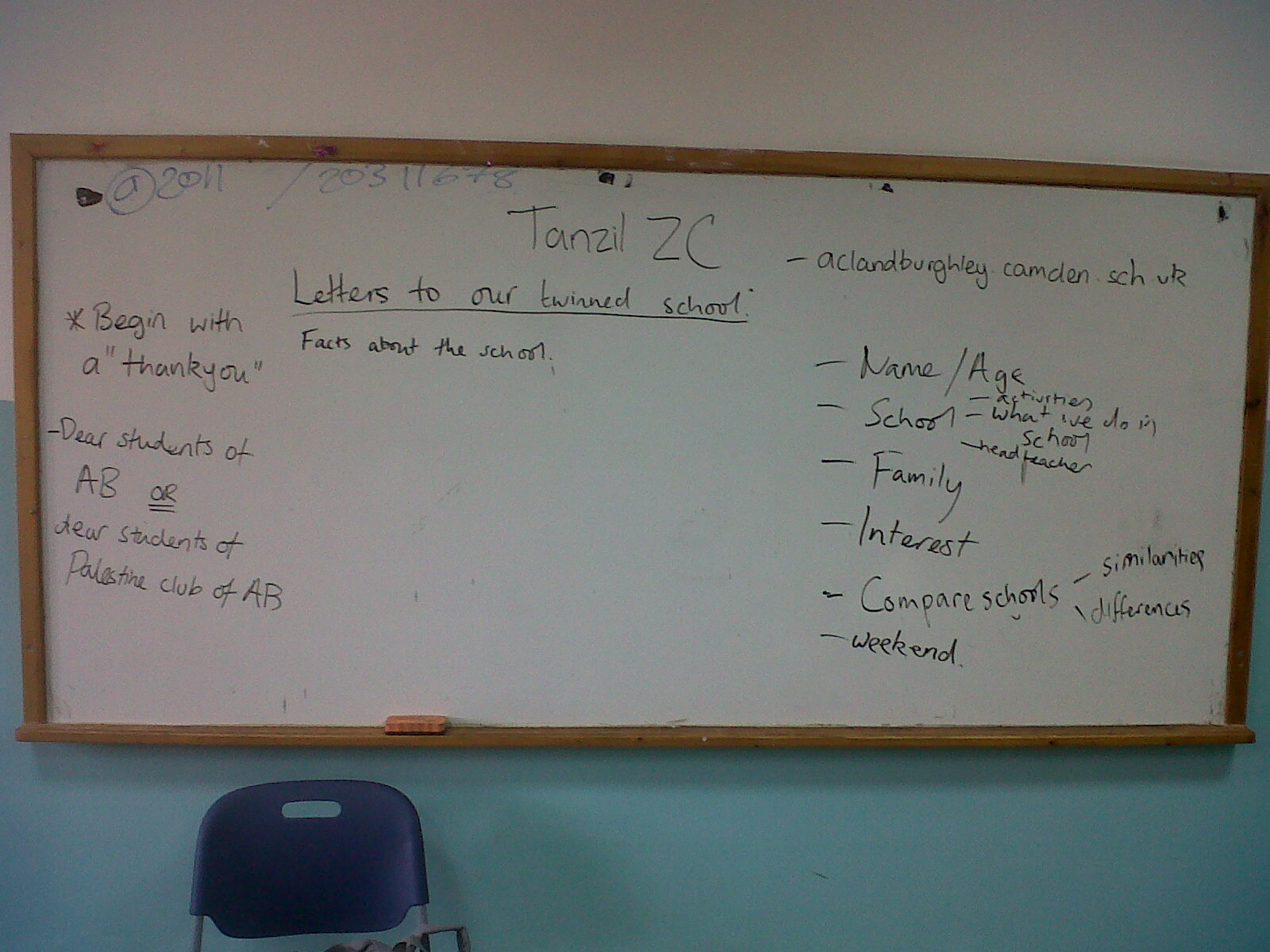
I sent the boys away with some homework; we eventually want to create letters to scan and email to the Palestine club. Rather than just send a normal letter, I asked them to bring in a picture or poem which 'defines' them or means something to them to form the introduction of the letter. Some suggestsions were pictures of the wall or Al-Aqsa mosque, some were poems by the famous Palestinian Poet, Mahmoud Darwish.

Next lesson, it will be interesting to see what they bring and hopefully we can begin with writing our letters!